
A lower monthly rent does not necessarily mean better value per square foot. When comparing monthly rates for self-storage units, it is important to look beyond just the monthly rent and also take into account the unit size, location, lease term and any additional charges, in order to determine whether the total cost is reasonable.
If you’re looking to free up space for household items, a house move or renovation, the rent is naturally an important consideration; however, a storage unit that is too small or inconveniently located may not be cost-effective in the long run.This article compares rental considerations across different areas of Hong Kong, explains how unit size and lease term affect the rent per square foot, and summarises the additional charges to watch out for when comparing prices, to help you make a choice based on your actual needs.
Key Points
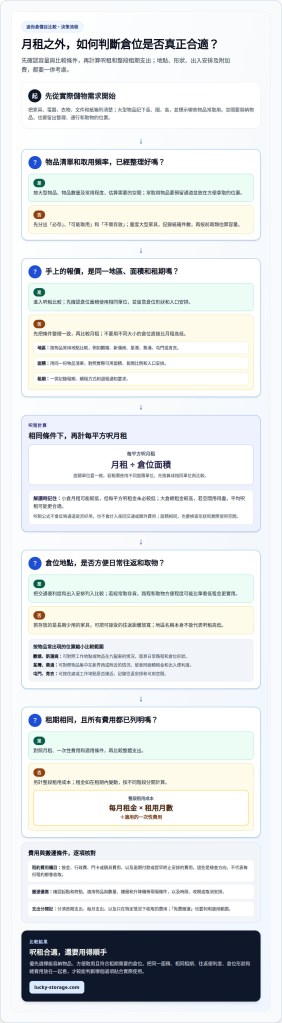
- First, estimate the space required based on the type, quantity and frequency of access to your belongings, then select a storage unit. This will help you avoid renting a unit that is too large or too small simply by focusing on the monthly rent.
- When comparing offers, pay attention to the scope of ‘free removal’ services and any charges that may apply in addition to the rent.
- Compare transport links and storage unit options across locations such as Kwun Tong, San Po Kong, Tsuen Wan, Kwai Chung, Tuen Mun and Tsing Yi; do not judge whether the rent is suitable based solely on the district name.
- When calculating the rent per square foot, consider both the monthly rent and the actual usable area; location, unit size and lease term will all affect the overall cost.
- Use a size calculator to work out the space required for your belongings, then compare self-storage units with mini-offices based on your storage or work needs.
Contents
- Unit Sizes and Storage Requirements
- Free Transport and Other Additional Charges
- Comparison of Monthly Rents and Unit Sizes Across Districts
- How Location, Size and Tenancy Term Affect Rent per Square Foot
- Lucky Storage: Self-Storage
Storage Unit Sizes and Storage Needs
When choosing a storage unit, don’t jump straight to estimating the monthly rent. Start by taking stock of your belongings. Sofas, mattresses, cardboard boxes and suitcases all take up space in different ways. Even with the same floor area, the usable space will vary depending on how items are stacked. Drawing up an inventory of your belongings will make it easier to compare the suitability of different storage units.
The first step is to sort items by category. Keep furniture, electrical appliances, clothing and documents separate.For large pieces of furniture, note down the length, width and height; for cardboard boxes, estimate the number and dimensions. Items such as fridges and washing machines have relatively fixed shapes, so it’s best to measure their most protruding parts first. This way, when comparing storage units, you won’t be relying solely on photographs or your memory.
Step two: Categorise items by storage duration. Seasonal clothing, suitcases and spare household items can usually be grouped together. For documents, tools or goods that you access daily, ensure you leave sufficient space for access and manoeuvring. If you stack frequently used items at the very bottom, the storage space may appear more efficiently utilised, but retrieving items will actually be more troublesome.
Step 3: Plan the order of placement.Start by placing large, less frequently used items, then arrange cardboard boxes and small items. Ensure fragile items are not crushed by heavy objects. Label the outside of boxes with their contents, such as ‘winter clothes’ or ‘kitchenware’, to make finding items much quicker later on. If you need to access items frequently, place the relevant boxes near the entrance.
When estimating capacity, do not treat the storage space as an empty box with no height restrictions. The shape of furniture, the weight-bearing capacity of boxes and the stability of stacks will all affect the usable space.Mattresses can be stored upright or laid flat, depending on the layout of the storage unit and how you wish to protect them; for long pieces of furniture, check whether the entrance and aisles can accommodate them. Even if the floor area is similar, different shapes can affect how efficiently items can be arranged.
If your budget is tight, do not simply opt for the smallest storage unit. If cardboard boxes block the entrance or large pieces of furniture cannot be manoeuvred, you will find yourself stuck when trying to access your belongings.Conversely, if your belongings consist of only a few suitcases and a small number of boxes, an overly large space may go underutilised. You could first categorise your items into ‘must-store’, ‘may need to access’ and ‘no need to store’, then estimate your requirements based on the first two categories.
| Choosing a Storage Unit | Suitable Items | Access Arrangements | Key Considerations |
|---|---|---|---|
| Smaller Storage Units | Suitcases, seasonal clothing, a small number of cardboard boxes | Items are sorted and stored in one central location | Is the entrance likely to be blocked by boxes? |
| Medium-sized storage space | Cardboard boxes, chairs, small electrical appliances | Leave a clear passageway; place frequently used items at the front | Can furniture and cardboard boxes be kept in separate areas? |
| Larger storage units | Sofas, mattresses, a large number of furniture items and boxes | Arrange items according to how often they are used | Can large items be moved in and out easily? |
| Space for work purposes | Documents, goods and work equipment | Arrange according to daily workflows | Should storage and work areas be separated? |
When making your choice, first determine your requirements based on large items and how frequently you’ll need to access them, then compare the sizes of the storage units; even if your list fits within the space, you’ll need to leave room for actually organising and retrieving your belongings.
When using this approach to review monthly self-storage rates, the key consideration is not just the advertised unit size, but how much usable storage space you actually get for your monthly rent. If you are decluttering your home, storing renovation materials or small business stock, list your items, furniture dimensions and access habits together to make comparisons clearer.
Free removal and other additional charges
The phrase ‘free removal’ does not necessarily mean that all items are included. Break down the service details first. Where does the removal service start? Is it limited to specific locations? Does it apply equally to large furniture, cardboard boxes and electrical appliances? List the scope item by item to ensure a fair comparison with other storage arrangements.
When organising your belongings, start by noting down the number of items and their types. For example, sofas, mattresses, cardboard boxes and fridges each have different handling requirements. Next, record the floor levels involved, whether a lift is available, and whether any items require special handling. This information will influence the removal arrangements and can help minimise additional costs arising from misunderstandings.
When comparing ‘free’ offers, examine the following points one by one:
- Scope of the move: Confirm the starting point, destination and whether the service includes transport from your home to the storage unit.
- Item restrictions: Check whether there are separate arrangements for large furniture, electrical appliances or specific items.
- Quantity of items: Check the number of items, boxes or categories of items to which the offer applies.
- On-site conditions: Note details such as the floor level, stairs, lifts and parking facilities.
- Time arrangements: Confirm the available time slots, as well as the procedures for rescheduling or cancelling.
Do not rely solely on advertising claims. If the terms state ‘specified removal’, check whether this refers to distance, quantity of items or method of removal. If the offer applies only to certain items, arrangements for items outside this scope may need to be made separately. When comparing quotes, keep a separate record of what is included and what is excluded.
In addition to the rent, pay attention to other fee items listed in the contract.Identify, item by item, those charged monthly, as a one-off, or based on usage. Potential charges may include security deposits, administration fees, access card or lock fees, as well as charges for late payment or early termination. These are points to check when reading the terms and conditions; they do not necessarily apply to every tenancy agreement.
Before making any payment, calculate the initial outlay separately from the subsequent monthly payments. The initial portion should cover the security deposit, administrative charges and move-in arrangements; the monthly portion should cover the rent and any recurring charges.If a charge is only applicable under specific circumstances, make a note of the triggering conditions, such as late payment of rent, loss of an access card or early termination of the tenancy. Checking each item individually is more practical than simply looking at the first-month’s special offer.
If the tenancy period is not yet fixed, pay particular attention to the minimum tenancy period, renewal procedures and notice requirements for terminating the tenancy. For short-term storage, you may place greater emphasis on the arrangements for moving in and out; for long-term storage, you should factor periodic charges into your total expenditure. Mini-storage monthly rental rates should be considered alongside the terms and conditions; do not simply compare the figures listed under ‘monthly rent’.
Finally, compile a single checklist of all the different options: monthly rent, one-off fees, scope of removal services, additional conditions and termination arrangements.If you come across the word ‘free’, make a note of the items to which it applies and any restrictions; if there are fee items that are not clearly specified, clarify them based on the quotation before including them in your comparison. Prices will vary depending on the unit type, location, tenancy period and handling arrangements, so you will need to check individual quotations.
Comparison of Monthly Rents and Storage Unit Sizes Across Different Districts
Monthly rents across different districts in Hong Kong cannot simply be ranked by district name alone.Kwun Tong, San Po Kong, Tsuen Wan, Kwai Chung, Tuen Mun and Tsing Yi should all be included in your comparison; even within the same district, unit size, building location and lease term will affect the quoted price. When comparing options, use the same set of criteria; otherwise, an option that appears cheaper may not actually offer comparable space.
First, select the districts that are actually acceptable to you. If your belongings are mainly used in Tsuen Wan, compare options near Tsuen Wan first, then consider whether Kwai Chung or Tsing Yi are convenient to travel to and from.If you live in Kwun Tong, you could include San Po Kong in the first round of comparisons. This is not about ranking options by rent, but rather about minimising the daily journey to collect your belongings first, and then comparing costs under the same conditions.
Next, standardise the storage unit size. Assuming you need to store cardboard boxes and a mattress, apply the same list of items to each area, noting the available space, the layout of the unit and the access arrangements.Do not compare the monthly rent of a small unit in Tsuen Wan directly with that of a large unit in Tuen Mun; as the floor areas differ, the total rent naturally does not accurately reflect the cost per square foot.
When comparing monthly rates for self-storage units, it is advisable to record the following details item by item:
- Area: for example, Kwun Tong, San Po Kong or Tsuen Wan.
- Unit size: Note the actual area and the length-to-width ratio.
- Monthly rent: Compare only quotes for the same storage unit size and tenancy period.
- Convenience of access: Calculate the distance from your home, office or workplace to the storage unit.
- Additional terms: List any one-off fees and lease arrangements separately.
Even for units of the same size, the shape matters. Elongated units are suitable for long pieces of furniture, but it may be more difficult to organise boxes into separate zones; in more square spaces, arranging shelving and aisles is straightforwarder.For small businesses in Kwun Tong that frequently access their stock, travel distance and access arrangements may be more important than simply looking for the lowest rent. For families in Tuen Mun who are only storing seasonal items, priority should be given to whether the capacity is sufficient and whether access is convenient.
| Comparing Areas | Situations suitable for comparison | Points to Note |
|---|---|---|
| Kwun Tong, San Po Kong | Workplace or items located in Kowloon East | Daily journey to collect items, layout of storage space |
| Tsuen Wan, Kwai Chung | Items are concentrated in New Territories West or the surrounding area | Rent per square metre, ease of access |
| Tuen Mun, Tsing Yi | Proximity to home or workplace | Commuting time, available space |
Finally, list all options with the same floor area, tenancy period and pricing terms in the same column, then compare the rent per square foot. Rent per square foot can be calculated by dividing the monthly rent by the storage unit’s floor area; ensure that the units of measurement are consistent. If one quote is listed in square feet and another in a different unit, convert them to the same unit before making a fair comparison.
When selecting a location, first narrow down the search based on where your belongings are most frequently kept, then choose quotations with the same floor area and tenancy term; consider the journey time, the layout of the storage unit and the total cost together to determine which option best suits your day-to-day needs.
The impact of location, size and tenancy term on rent per square foot
Rent per square foot must be compared under the same conditions. The calculation is straightforward: monthly rent divided by the storage unit’s area. If two quotes differ in area or tenancy period, simply comparing the monthly rent amounts can easily lead to incorrect conclusions. Standardise the area units first, then calculate the monthly rent per square foot to accurately assess the cost per unit of space.
Location influences your choice. Take Kwun Tong and Tsuen Wan as examples: first consider where you will be accessing your belongings, then compare storage units of the same size.If you need to make weekly trips, convenience of travel may be more practical than the apparent difference in rent; if you are storing furniture that is rarely used over the long term, you can be more flexible regarding the acceptable travel distance. The name of the district alone does not indicate the level of rent per square foot; you must also consider the storage unit’s conditions and its actual intended use.
The size of the unit will also affect the calculation. The monthly rent for a small unit may be lower, but the rent per square foot may not necessarily be lower; whilst the total rent for a large unit is higher, if the space is utilised fully, the average rent per square foot may be more cost-effective.Compare using the same list of items, such as sofas, cardboard boxes and suitcases, and confirm whether each unit can accommodate them and allows for easy access. Simply comparing the area stated on the unit door, whilst ignoring the shape and access corridors, will result in a rent-per-square-foot figure that does not reflect the actual practical value.
The tenancy term affects total expenditure. Compare short-term and long-term storage separately, noting down the tenancy period, renewal arrangements and termination clauses for each. If two options have the same monthly rent but one requires a longer tenancy term, the total expenditure and flexibility will differ.Do not base your decision solely on the monthly rent, nor should you treat short-term promotions as fixed costs for the entire tenancy period.
A practical comparison can be carried out in the following order:
- Select a district, such as Kwun Tong or Kwai Chung.
- Determine the required floor space and draw up an inventory of items.
- Record the monthly rent and lease terms for each storage unit.
- Divide the monthly rent by the floor area to calculate the monthly rent per square foot.
- Then compare ease of access and any additional charges.
For example, for Storage Unit A, record the monthly rent as ‘A’ and the floor area as ‘Area A’; for Storage Unit B, record the monthly rent as ‘B’ and the floor area as ‘Area B’.Divide the monthly rent by the area for each to compare their rent per square foot. This formula does not reflect the ease of access, nor does it take into account travel time or additional charges; therefore, you should still consider the terms of use alongside it.
Where lease terms differ, calculate the total cost for the entire tenancy period separately.Multiply the monthly rent by the number of months, then add any applicable one-off fees; if the rent varies during the tenancy period, calculate the figures separately for each stage. This approach ensures that when comparing options in Kwun Tong, Tsuen Wan or Tuen Mun, you do not confuse quotes with different tenancy periods.
When compiling a list of monthly self-storage prices, you can use a table to record the location, size, monthly rent, rent per square foot and tenancy period. First, select units that can accommodate your belongings, then sort them by the location where you’ll most frequently collect your items, and finally compare the total cost for the entire tenancy period.When estimating dimensions, use a self-storage size calculator to determine the space required, then compare options based on the same floor area.
Lucky Storage: Self-Storage
Lucky Storage provides a size calculator to help you work out the space required based on your inventory list. Start by entering details of items such as furniture and cardboard boxes, then compare the estimated results alongside your budget, location and tenancy period to make a more informed choice.If your needs extend beyond simply storing items to requiring a space for day-to-day work, you may also wish to explore whether a mini-office would be suitable. Once you have organised the types of items, their frequency of access and the anticipated rental period, consider your next steps based on your actual requirements. If you would like to find out more about space planning, please feel free to contact Lucky Storage.
Allow for flexibility for the next stage
Storage arrangements can also adapt to changes in your life. When the purpose of your belongings, your working style or your living arrangements change, reassess your needs to determine whether your current space remains suitable. If you’re organising your home or workspace, use the size calculator to estimate the space required, then consider whether a self-storage unit or a mini-office better suits your needs.If you’d like to explore storage options tailored to your own circumstances, please contact Lucky Storage for further information to help you find the right direction for your next step in space planning.