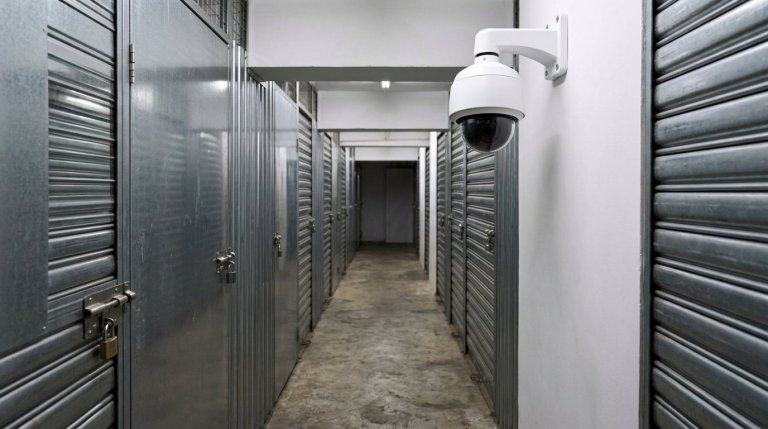

When assessing the security of a self-storage facility, it is not enough to simply check whether CCTV is in place; you must also understand how the facility’s smart access control system manages entry and exit, as well as the arrangements for on-site patrols.This article outlines key assessment criteria—including CCTV, smart access control, facial recognition, on-site inspections and round-the-clock patrols—to help you determine whether different arrangements meet your storage needs.
Key points
- When assessing access control arrangements, pay attention to how access rights are managed and how tenants gain entry to their own storage units.
- Understand the CCTV’s coverage area and operational arrangements to determine whether it covers the communal areas of concern to you.
- Compare facial recognition and smart card access methods, noting whether they are intuitive and convenient for day-to-day use.
- During an on-site inspection, observe the layout of entrances, passageways and security equipment to gain an understanding of the overall management arrangements.
- Understand how patrol arrangements complement access control and surveillance, and assess your requirements based on the items you store and your usage habits.
1. 24-hour surveillance and smart access control
When assessing the security of self-storage facilities in Hong Kong, it is important to first distinguish between the roles of surveillance and access control. 24-hour video surveillance records footage of designated areas, whilst smart access control manages who is permitted to enter the premises. The two address different aspects and cannot replace one another. Before renting, find out how entry and exit points are controlled, and then check which communal areas are covered by the cameras.
‘24-hour surveillance’ does not necessarily mean that someone is constantly monitoring the footage on site. Whilst surveillance cameras may continuously record footage, real-time monitoring involves staff paying immediate attention to the footage and responding to any anomalies. When assessing the arrangements, it is important to distinguish between these two concepts to avoid mistaking continuous recording for live monitoring.
The key aspect of smart access control is how access permissions are configured. This can be understood by examining the actual entry process: how tenants obtain access credentials, how they pass through the facility’s entrance, and how they reach their own storage units. If the entrance and the unit are located in different places, it is also important to ensure that the control procedures for both locations are clearly defined.By examining the process in stages, it is easier to identify at which points the access control system comes into play.
Check whether access methods are personalised. Access cards or smart identification systems should allow tenants to enter in a designated manner, rather than simply through a door that is always open. You can check whether there are card readers or identification devices at the entrance, and also enquire about the procedure for dealing with lost cards. The appearance of the equipment itself does not necessarily indicate how access is managed.
When assessing CCTV, focus on the placement of cameras rather than just the number of lenses. As you walk from the building entrance to the self-storage entrance, note whether there are surveillance devices at corners, in corridors and along passageways. The direction of the cameras, any obstructions to the line of sight and the positioning of the entrances will all affect what is captured on camera.Making a note of the locations you observe along the way is more practical than simply counting the number of cameras.
You can divide your site inspection into two steps. Firstly, follow your usual route to observe the positioning of surveillance cameras at entrances and along public corridors. Secondly, familiarise yourself with how the smart access control system is operated and the route to your storage unit once you have gained access. This allows you to cross-reference the actual route with the layout of the equipment, avoiding the pitfall of making judgements based solely on the fact that ‘surveillance is in place’.
If you are storing stock for an online shop, you will be more concerned with whether access routes are clearly visible and whether the access control system is user-friendly when collecting goods on a daily basis. If you are storing household items, you should pay closer attention to the communal corridors through which items will be moved during handover. Assessing the situation based on the items and usage scenarios will allow you to identify more specifically which arrangements are relevant to your needs.
Finally, do not assume that ‘access control’ means the same management approach is applied across all areas. The building entrance, communal areas of the self-storage facility and individual storage units may each have different access arrangements. By understanding who is authorised to access each area and how, and taking into account the positioning of CCTV cameras, you will gain a more comprehensive understanding of the facility’s overall layout.
2. 24-hour CCTV surveillance
The value of CCTV also depends on how the footage is managed. When assessing the system, find out how faults are handled, when recording stops, and how the system’s operation is verified once it has been restored. These arrangements determine whether monitoring is continuous; this cannot be judged simply by looking at the cameras on the wall.For information on recording retention periods, night-vision performance and recording arrangements during power cuts or internet outages, please refer to the section on CCTV recording retention and night-vision arrangements for self-storage facilities.
Check whether there are regular inspection or maintenance procedures in place for the equipment. You should find out how the person in charge detects faults with cameras or recording equipment, and how matters are handled whilst repairs are being carried out. In the event of a fault, clear reporting and follow-up procedures provide a better indication of whether the management is well-organised than simply being told that ‘CCTV is in place’.
It is also important to understand the procedure for accessing the footage. Should a tenant notice any irregularities with their belongings, they should know how the incident is recorded, who handles it, and how access to the footage is carried out in accordance with established procedures. This does not mean that tenants can view the footage themselves; the key point is whether the management has clear procedures in place to ensure incidents are followed up through the appropriate channels.
As the footage involves personal data, the management of this data is equally worthy of attention. You should find out who has authorisation to access the recordings, how unauthorised persons are prevented from viewing them, and how the data is stored and processed. These details need not rely on technical jargon; the ability to clearly explain management responsibilities and access procedures is, in itself, a practical basis for assessment.
For example, suppose you move a box of documents only to discover later that the contents are not as expected. When dealing with this, first make a note of the circumstances of the discovery and the approximate time, then follow up in accordance with the premises’ incident handling procedures. How the management receives the information, organises an investigation and responds will determine whether the CCTV footage can support the subsequent process. The recording equipment itself will not automatically resolve the incident.
Do not assume that the video retention period is a fixed standard. Settings and management practices may vary between different systems; the key focus of your assessment should be on understanding how footage is stored, how it is accessed in accordance with procedures, and how related records are managed. If you are storing important documents or goods for an online shop, these processes will help you understand how the equipment can support the handling of incidents once they occur.
During a site visit, focus your questions on three key areas: how the equipment is maintained, how faults are addressed, and how footage is managed. If the answers merely mention the equipment’s model names, you will still struggle to grasp the practical operations. Making a note of the answers and then assessing your needs based on the nature of the items you store will prove far more useful than simply relying on the phrase ‘24-hour surveillance’.
CCTV is a management tool, not a guarantee of the condition of your property. Understanding the video management processes will give you a clearer idea of how to follow up should an incident occur, and will prevent you from mistakenly assuming that the mere presence of surveillance equipment guarantees that an incident will be detected immediately or fully reconstructed.
3. Facial Recognition and Smart Card Access Control
Facial recognition and smart cards are both methods of access control. When assessing these systems, first examine how each verifies the user’s identity, then consider the procedures following entry. Facial recognition relies on facial features for identification, whilst smart cards require the card to be scanned. Neither should be regarded in isolation as a comprehensive security measure; they must be complemented by access rights management.
During an on-site observation, begin by examining the identification devices at the entrance. If facial recognition is used, note whether users need to stand in a specific position and whether there are clear instructions for proceeding once recognised. If smart cards are used, observe the card-reading position and the door-opening process. These details will help you understand whether the equipment is user-friendly and whether the access procedures are clear.
Next, consider the process in a real-life scenario. If you are carrying a cardboard box or goods from an online shop to the warehouse, your hands may be occupied and you may not be able to hold your smart card; facial recognition, meanwhile, requires you to face the device directly. Both methods have their own conditions for use, and the actual user experience will also be influenced by the location of the entrance and the operational prompts provided.Observing a single instance of normal entry and exit provides a better understanding of whether the system suits your access habits than simply looking at the equipment’s name.
It is also worth paying attention to how smart cards are managed. Find out how tenants obtain their cards, how the cards work with the access control system, and what happens if a card is lost. These arrangements determine whether access rights can be managed properly. If several people from the same company need to collect goods, it is important to clarify how each user gains access individually, to avoid mistaking the convenience of a single card for a multi-user access arrangement.
Facial recognition can be understood through three key stages: registration, usage and modification.During registration, how do users set up their identification details? During day-to-day access, how does the equipment indicate whether recognition has been successful or not? When a tenant replaces a user, how are access permissions updated? These are all practical procedural issues. Understanding the answers will help you judge whether the system is easy to manage, rather than simply looking at whether there are recognition cameras at the entrance.
As facial recognition involves personal data, when evaluating the system, you should understand how data is collected, used, stored and deleted. This is not a question that can be answered simply by looking at recognition speed. You should also note whether there are clear instructions for use on site, as well as the procedures to follow in the event of a recognition failure. If data management is important to you, these arrangements should be considered alongside the convenience of access.
When comparing the two methods, you can follow a step-by-step approach along an actual route: first, confirm which recognition method is used at the entrance; next, note how the system indicates the access result; and finally, understand the procedures for changing access rights and handling expired cards.Facial recognition does not guarantee successful identification every time, nor do smart cards automatically ensure flawless access management. The equipment, operation and management processes must all be considered together.
For frequent users, the clarity of the operation directly affects day-to-day access; for those who only access the facility whilst moving house or during renovation work, it is worth paying particular attention to whether the system is easy to understand on first use.When assessing access control for self-storage facilities in Hong Kong, one should not merely compare whether facial recognition or smart cards is the newer technology. Instead, one should consider the specific usage scenarios: how access rights are configured, how entry and exit are carried out, and how exceptional circumstances are handled.

4. On-site inspection of security facilities
When you book a viewing, walk the route you would take to access your storage unit. Start at the building entrance, proceed through the communal corridors, and continue to the entrance of the storage area. Pay close attention to the location of doors, corridor bends and the placement of equipment at each stage. This approach makes it easier to spot details that are not visible from the reception area alone.If you intend to store large cardboard boxes, also note whether you will need to navigate any tight corners whilst moving them. When assessing the security of a Hong Kong self-storage facility, walking the route yourself allows for observations that more closely reflect everyday use.
First, examine the practical operation of the entrance and doors. Observe how the doors open, whether they close properly once shut, and whether the entry and exit procedures are clear. If the entrance is fitted with an access control system, check that the operating instructions are easy to understand.Next, check whether there are any situations outside the door where others could easily follow you in. A single inspection can only reflect what you see at that moment, so it is advisable to make a note of the procedures you observe to facilitate future organisation and comparison.
Next, walk slowly along the communal corridors. Pay attention to corners, pillars, areas behind doors and large objects – all of which may obstruct the line of sight. These locations can affect your observation of the on-site environment and also help you understand the orientation of the CCTV cameras.Do not focus solely on the number of cameras, nor should you make assumptions about what the cameras can capture. Simply observe the camera positions and then familiarise yourself with the descriptions of their coverage areas.
Identify clearly the boundary between communal areas and individual storage units.Stand in the corridor and observe the unit entrances, noting whether they are easily identifiable from outside and whether the passageways are obstructed by items. If people are moving goods in or out, you can also observe their routes to see whether they can pass through smoothly whilst carrying cardboard boxes. The purpose of the on-site inspection is to understand everyday usage patterns, not to enter other people’s storage spaces.
Do not overlook lighting and directional signage. Observe entrance signs, corners and doorways from the corridor to see if it is easy to determine the direction of travel. If there are variations in lighting on site, note whether equipment in the passageways remains clearly visible. These are on-site conditions that can be recorded during an inspection; they do not imply that the overall level of security can be assessed on the basis of a single visit alone.Make a note of specific locations to avoid relying solely on vague impressions such as ‘well-lit’.
When conducting an inspection, you can follow a three-step process. Firstly, walk from the building entrance to the storage area.Second, note the locations of access control points, CCTV cameras and passageways along the route. Third, mark any areas where visibility is obstructed or operations are unclear, and then enquire about the relevant arrangements. Comparing different locations using the same route will give you a better understanding of the access environment than simply looking at promotional images.
If you are storing goods for an online shop, you can simulate a collection scenario: carry a cardboard box through the entrance and along the corridor, then walk back to the exit. If you are storing items for a house move or renovation, pay attention to whether large items can pass around corners with ease.An on-site assessment of security at a Hong Kong self-storage facility should also take these everyday movement patterns into account, ensuring that observations of the facilities are linked to actual usage requirements.
Finally, make a separate note of the facts you observe and your own inferences. For example, ‘there is a card reader at the entrance’ is a fact visible on site; ‘all entries and exits are recorded’ relates to the actual management arrangements.Organising your notes in this way will help you make a rational comparison of the various facilities. When assessing the security of a Hong Kong self-storage facility, observe each area—from the entrance and passageways to the unit doors—and then compare this with your own storage habits; this will make it easier to judge whether the environment is suitable for your needs.
5. Round-the-clock security patrols
When assessing patrol arrangements, first distinguish between ‘round-the-clock patrols’ and ‘round-the-clock manned posts’. The two are not the same thing.Patrolling involves staff following a set route to inspect the premises, whilst a static presence refers to staff remaining at designated posts. When assessing the security of a Hong Kong self-storage facility, you should first check whether there are clearly defined patrol routes between the entrance, communal corridors and storage areas.
The value of patrols lies not merely in the presence of personnel walking through the premises, but in whether the patrol routes cover areas that tenants are likely to pass through. For example, the passageway next to the entrance, the lift lobby and the corridors leading to the storage areas are all public spaces that should be monitored. If the route only passes through the lobby, this does not necessarily mean that other areas are included in the patrols.You can follow your own route when collecting items to see which areas the patrols cover.
Next, consider how patrol times are organised.Round-the-clock patrols do not necessarily mean that every location is under constant supervision, nor do they imply that staff will be present in all passageways at the same time. When assessing the arrangements, distinguish between patrol shifts, patrol routes and on-site staffing positions. Each of these arrangements addresses different issues; only when considered together can one see how the patrols align with daily comings and goings.
During an on-site visit, observe whether there are any records of patrols or notices regarding handover arrangements in the communal areas. If you see a patrol log, check whether it specifies locations, times and records of patrols carried out. This information helps to understand the management approach, but the log alone cannot prove the actual circumstances of every patrol.The key is to understand how patrols are organised, rather than simply checking whether documentation exists.
You may also wish to note the procedures followed when anomalies are detected.For example, if a cardboard box is left in a corridor, an entrance fails to close properly, or a passageway is blocked by an object, how do patrol staff record and follow up on such incidents? If the procedures are clear, it is easier to ascertain who is responsible for handling the matter and how responsibilities are handed over. These examples can help you understand whether patrols involve management steps beyond mere on-site observation.
It is important to distinguish between patrols, CCTV and access control.Access control manages entry and exit, CCTV records footage, whilst patrols monitor the condition of public areas through on-site inspections. Each serves a distinct purpose. Merely knowing that patrols are in place at a site does not allow you to determine which areas will be checked, how anomalies are recorded, or how different arrangements coordinate with one another.
You can review the patrol routes based on your specific usage scenario.If you frequently collect items at night, pay particular attention to the public passageways leading from the entrance to the storage area; if you mainly store items during a house move or renovation, observe the transport routes and the locations through which large items will pass. By comparing these areas with the patrol routes, you can assess the security of Hong Kong self-storage facilities in a way that better reflects your actual needs.
Finally, categorise your on-site observations into three groups: locations covered by patrols, visible patrol management notices, and procedures for handling anomalies.Do not interpret ‘patrols’ as meaning ‘the entire premises are under constant supervision’. When assessing the security of a Hong Kong self-storage facility, you should understand how patrols work in conjunction with access control and CCTV, and then judge whether the arrangements are clear based on your own access habits.
Lucky Storage
Lucky Storage offers self-storage units and mini-offices, equipped with CCTV surveillance and access control systems. Once a unit has been rented and an access card activated, tenants can access their units 24 hours a day.When considering security arrangements, you may wish to take into account your daily access habits and space requirements; the size calculator can help you estimate the storage space required based on your inventory list.
If you are considering storage space or office premises, please feel free to contact Lucky Storage to explore suitable options.
Start planning based on your day-to-day needs
Before choosing a storage space, organise your belongings by type, frequency of access and intended use. This information will help you determine which arrangements best suit your lifestyle or work routine. When assessing the security of mini-storage units in Hong Kong, you should also take your actual access requirements into account to ensure your choice is well-suited to long-term use.
The Lucky Storage team can assist you in understanding your options—including self-storage units, mini-offices and the space calculator—based on your storage or work requirements. Once you have prepared your inventory list or defined the intended use of the space, you’ll be in a much clearer position to take the next step. Contact Lucky Storage to enquire and take the first step towards organising your space.
Frequently Asked Questions
Do mini-storage units in Hong Kong have 24-hour CCTV surveillance?
Yes, some self-storage units in Hong Kong are equipped with 24-hour CCTV surveillance, and Lucky Storage also offers this service. Facility configurations may vary by location, so when making your choice, please check the surveillance arrangements for the specific unit you are renting.Before storing documents, collectables or online shop stock, you may also compile your own inventory list and make a note of the contents of each box to facilitate future management and retrieval.