When considering monthly self-storage rental rates in Hong Kong, it is not enough to look solely at the base rent; the location and storage unit size will affect the rent, whilst the security deposit, removal charges and lease term will also influence the total cost. When comparing monthly self-storage rates, you should first select a storage unit based on your actual needs, and then calculate all the costs together.
Focusing solely on the monthly rent can lead to overlooking additional costs upon moving in, and may result in renting a unit that is either too large or too small. Half-unit or smaller storage units are suitable for those with few items; if you have a lot of furniture or boxes, you’ll need to ensure there is sufficient available capacity.
The following section outlines how to compare options across different districts in Hong Kong, explaining how starting rates, unit sizes, security deposits, removal charges and lease terms affect your costs. After reading this, you’ll be able to estimate the most suitable unit and your overall budget based on the quantity of your belongings and the anticipated storage duration.
Key Points
- When comparing starting rental prices across different districts, it is important to consider both the unit size and the actual usable capacity; do not base your decision solely on the monthly rent.
- First, select a storage unit based on the quantity and size of your belongings, then consider whether you need to allow for extra space to avoid renting a unit that is too large or too small.
- When estimating total expenditure, list the deposit, removal costs and other additional fees separately from the monthly rent; this makes it easier to see the initial outlay clearly.
- The length of the tenancy and the convenience of accessing the storage facility will both influence your overall choice; compare options based on how long you plan to store your belongings and how often you’ll need to collect them.
- Make good use of the size calculator to work out the space required for your belongings, then compare this with options in different areas to narrow down the range of suitable storage units.
Starting Rental Rates for Different Self-Storage Companies
Starting prices usually correspond to the smallest available units and do not necessarily mean that all unit types are charged at the same rate.When comparing monthly self-storage rates, first check the area specified in the price list, then consider the actual storage capacity. If you simply compare the lowest monthly rates across different companies side by side, it is easy to overlook differences in unit size, and the results may not accurately reflect which option offers the best value for money.
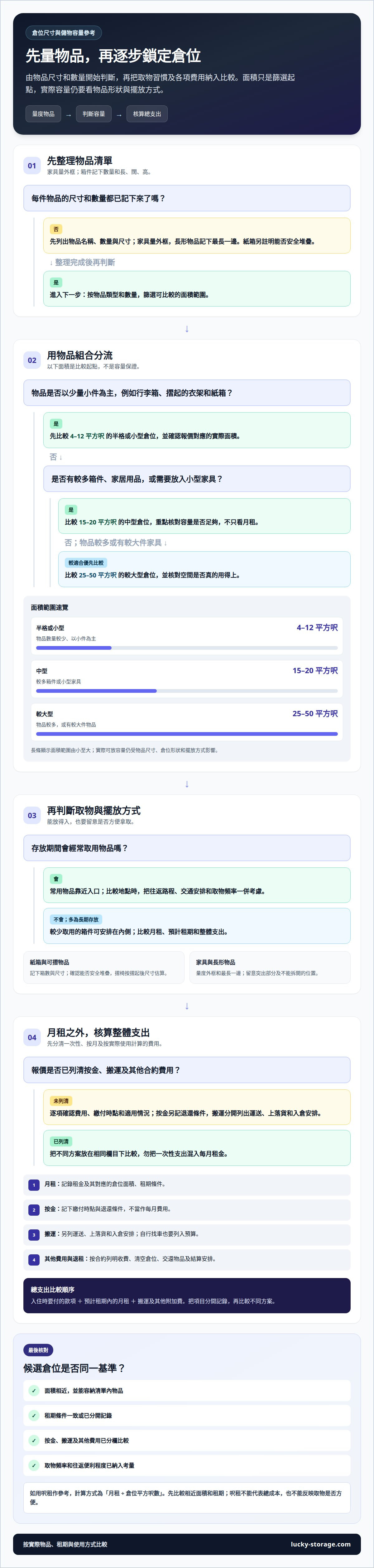
Common storage unit sizes in Hong Kong can be categorised as half-unit (4–12 square feet), 15–20 square feet, and 25–50 square feet. These size ranges can serve as a starting point for comparison, but one cannot judge solely by floor area whether furniture or cardboard boxes will fit.Suitcases, folding chairs and cardboard boxes come in different shapes, and the way they are stacked will also affect the usable space. Before making a comparison, make a list of the items you wish to store and note down the length, width and height of the largest item.
| Comparing Options | Common sizes | Factors to Consider When Comparing | Points to note when considering rental prices |
|---|---|---|---|
| Half-unit or small storage units | 4 to 12 square feet | Suitable for a small number of items, mainly small items | Check that the quoted price corresponds to the actual floor area |
| Medium-sized storage units | 15 to 20 square feet | Suitable for storing a larger number of boxes or household items | Compare storage capacity, not just the monthly rent |
| Larger storage units | 25 to 50 square feet | For a larger quantity of items, or larger items | Check whether you’ll be making full use of the space |
Next, examine the conditions attached to the advertised rental price. The lowest price may only apply to specific sizes, tenancy periods or promotional offers; monthly rent may also vary depending on the size and location of the unit.When comparing options, list the storage unit size, lease term requirements and fee items for each option in a single table to avoid treating figures with different conditions as comparable prices. If two units differ in size, first compare the monthly rent per square foot, then consider whether the capacity meets your needs.
A practical comparison can be carried out in three steps. First, narrow down the range of units that accommodate the size of your belongings. Second, compare the starting rental conditions of each company and note down the unit types and tenancy periods to which those prices apply.Third, list security deposits, removal arrangements and any other additional charges separately, and calculate the initial payment and total expenditure over the anticipated tenancy period. For example, if you are only storing a few boxes of clothes, the smallest unit may be sufficient; however, if you also have bookshelves or large suitcases, you must first check the layout of the space and not simply choose a unit based on a lower starting rent.
Therefore, the rental price is best used for initial screening and should not be the sole basis for a decision. Compare the storage area first, then the tenancy period and additional charges, to fully appreciate the differences between the various quotes. When making your choice, prioritise a unit that can accommodate the items on your list and whose terms align with your anticipated storage duration.
Storage Unit Sizes and Capacity Guide
Even with the same floor area, the items that can be stored may vary. The reason is simple: cardboard boxes can be stacked, and folding chairs can be placed against the wall; mattresses or bookshelves, on the other hand, are more difficult to rearrange.When estimating capacity, in addition to square feet, you should also list the length, width, height and orientation of your items. Comparing storage units in this way is more practical than simply looking at the ‘square feet’ figure.
Common options can be grouped into three size categories: half-unit or 4–12 square feet, 15–20 square feet, and 25–50 square feet. For the smaller range, consider suitcases, folded clothes hangers and cardboard boxes;medium-sized units are suitable for situations where you have a larger number of items or need to store small pieces of furniture; larger units can be used to accommodate multiple pieces of furniture and boxes. These are merely guidelines for narrowing down your options; actual capacity will still depend on the dimensions of your items and the shape of the storage unit.
It is a good idea to draw up a checklist to estimate each item individually. Start by listing the names of the items, then note their maximum dimensions—for example, wardrobes, bookshelves, suitcases and cardboard boxes.For furniture, measure the outer dimensions rather than just the internal space where items will be placed; for cardboard boxes, note the number of boxes and whether they can be safely stacked. If a bookcase cannot be dismantled, allow space based on its overall volume; if a folding chair can be folded, take its dimensions when folded into account.
- Cardboard boxes: Note the number of boxes and their length, width and height, and indicate whether they can be stacked.
- Furniture: Measure the outer dimensions, paying attention to protruding parts and sections that cannot be dismantled.
- Elongated items: Note the longest side and check whether the storage space can accommodate it.
- Frequently used items: Place these at the top of your list and reserve a spot where they are easy to access.
Capacity is not just about ‘fitting things in’, but also about ‘being able to get to them’. If cardboard boxes are piled up at the entrance, it will be difficult to retrieve suitcases or documents from inside; if every item has to be moved out of the way frequently, the space may not be used efficiently.You can start by categorising items into ‘long-term storage’ and ‘frequent access’. Place boxes you access less often towards the back, whilst keeping frequently used items close to the entrance. This approach is particularly suitable when storing both household goods and documents.
Finally, cross-reference your inventory list with the available storage areas one by one. If your list consists only of small boxes, start by comparing options ranging from four to twelve square feet; if you also have bookshelves or multiple pieces of furniture, consider storage units of fifteen to twenty square feet, or larger.A size calculator can help you determine the space required; simply enter the types and quantities of your belongings, then adjust your selection based on how you plan to arrange them. When estimating, it is more practical to leave space for accessing your items than to pack every inch to capacity.
Deposits, Transport and Additional Charges
The monthly rent is just one of the expenses. When comparing options, keep separate records of the payments due upon signing the contract, any charges that may arise during the tenancy period, and the arrangements for moving in.Take storing cardboard boxes as an example: initial costs may include the monthly rent and a security deposit; if you need to move in shelving units, you’ll also need to factor in the cost of transport, which you’ll arrange yourself. By keeping different items separate, you’ll avoid mistaking one-off expenses for monthly rent.
Check the payment method and refund conditions for the security deposit carefully. First, note down the amount of the deposit, when it is due, and how the lease agreement handles its refund; then check whether you need to clear out the unit, return the keys or arrange for cleaning of the storage unit when terminating the lease. These conditions will affect the final amount you can recover.When comparing two tenancy agreements, do not simply note down ‘deposit required’; also list the refund arrangements in the same column to facilitate a side-by-side comparison.
As for removal costs, clarify who is responsible for organising them and what work is included. If you arrange your own transport, the cost will depend on the distance, the volume of your belongings and the number of items; for example, even with cardboard boxes, as the quantity increases, the type of vehicle required and the time needed for the move may vary.For large items of furniture, you should also consider whether they can be dismantled, as well as the distance from your home to the vehicle. Estimating the costs of transport, loading and unloading, and storage separately makes it easier to identify which aspects are driving up your budget.
Other costs should be itemised according to the tenancy agreement; do not simply copy the total amount. A comparison table may include the following items:
- Security deposit: Record the payment date and conditions for its return.
- Removal: List transport, loading/unloading and storage arrangements separately.
- Additional rental items: Note the charges specified in the contract and the circumstances under which they apply.
- Termination arrangements: Specify the procedures for clearing the storage unit, returning items and settling accounts.
For example, Option A has a lower monthly rent but requires a security deposit to be paid upfront; Option B has a higher monthly rent, but the tenant is responsible for arranging their own removal.Comparing only the monthly rent overlooks the initial cash outlay and transport costs. You should first calculate the amount payable upon moving in, then estimate the monthly rent for the entire tenancy period, and finally add the cost of transport arranged by yourself. By listing these three components separately, you can compare the total expenditure rather than just the apparent rent.
Before signing the contract, organise the information into five columns: ‘Monthly rent’, ‘Security deposit’, ‘Removal costs’, ‘Other contractual fees’ and ‘Termination arrangements’.Indicate for each item whether it is a one-off payment, a monthly charge or calculated based on actual usage. If you arrange your own removals, keep the transport costs in a separate ledger and do not mix them with the storage rent. This approach applies to different items such as cardboard boxes, suitcases and furniture, and allows different rental options to be compared on a level playing field.
The relationship between tenancy period, location and rent per square foot
The tenancy period and location will affect the comparison results. First, specify the storage duration clearly, then compare storage units of the same area within the same district.When comparing options in Kwun Tong and Tsuen Wan, you should first compare them individually; do not simply look at the monthly rental figures for both. As storage units vary in size and lease terms differ, the quotes are not on the same basis. Only by standardising the conditions can you see the impact of location and space on the monthly rent.
The anticipated duration of storage will influence how you compare tenancy agreements. For temporary furniture storage during refurbishment, the key consideration is when you expect to collect your belongings; for seasonal household storage, you should consider whether items will be rotated regularly. If the storage period is not yet confirmed, record different tenancy arrangements separately and compare the billing methods when the tenancy period changes.Do not directly compare the discounted monthly rent for longer tenancies with short-term options. The total cost and flexibility of use may differ between the two.
Location should also be assessed based on your actual itinerary. If you live in Kwun Tong, travelling to a warehouse in the same district may be more convenient; if your work and daily activities are centred in Tsuen Wan, a nearby storage unit may be more convenient for collecting items. This is not a guarantee of lower rent, but rather a usage cost that should be factored into your comparison.Every time you collect items, you need to arrange transport and set aside time; the more frequently you collect items, the more worthwhile it is to factor in the journey time. For items used infrequently over the long term, you should weigh up the monthly rent against the transport arrangements.
Rent per square foot can be used to compare units of different sizes, but you must first ensure that the monthly rent and floor area figures correspond. The calculation is the monthly rent divided by the unit’s square footage.The resulting figure is only for like-for-like comparisons; it does not represent the total cost, nor does it reflect the ease of access. For example, if two storage units have different sizes, calculate the rent per square foot for each first, then assess whether the larger space is actually needed. If the extra space remains unused for long periods, a lower rent per square foot may not necessarily be the more suitable option.
- First, group them by district, such as Kwun Tong, Tsuen Wan and Kwai Chung.
- Within each group, compare only units of similar size and with the same tenancy terms.
- Divide the monthly rent by the number of square feet to work out the rent per square foot for reference.
- Assess whether the journey to and from the storage unit is convenient, taking into account the frequency of collection.
- Record the expected tenancy period and any potential extension arrangements separately.
Finally, compare the tenancy period, location and rent per square foot in that order. First, rule out unsuitable areas, then filter by the expected storage duration, and finally calculate the rent per square foot for similar storage units.If items are retrieved only rarely, prioritise the monthly rent and storage duration; if frequently used items are stored, travel time should also be taken into account. Comparing in this way ensures that a lower rent per square foot does not lead to overlooking the suitability of the lease term and day-to-day usability.
Comparison of Monthly Mini-Storage Rental Rates Across Hong Kong Districts
When comparing quotes from different areas of Hong Kong, it is essential to take into account both the storage unit size and the lease term. Judging which option offers better value based solely on the district name is not sufficient. When collating monthly rental rates for self-storage units, you may first group them by Kwun Tong, San Po Kong,Tsuen Wan, Kwai Chung, Tuen Mun and Tsing Yi, and then compare items with similar conditions one by one. The size of individual units and lease arrangements within each district will also affect the quoted prices; you cannot assume that the entire district has the same rates.
Start by selecting a comparison range based on your daily routine. If you mainly work in Kwun Tong on weekdays, options near Kwun Tong may be more convenient for collecting items after work; if your home and activities are centred in Tsuen Wan, you might first compare Tsuen Wan and Kwai Chung.Readers living in Tuen Mun or Tsing Yi can also use the same method, taking their home, workplace and regular routes as a starting point. By narrowing down the area first and then looking at rental rates, it is easier to balance convenience and cost.
When comparing quotes, record the same details for each area. These include the storage unit size, monthly rent, security deposit, lease terms and any other charges.Then sort the quotes by size range; for example, group together options between 15 and 20 square feet. If a quote from Kwun Tong corresponds to a smaller unit whilst one from Tsuen Wan corresponds to a larger one, the two cannot be directly compared. By grouping them first, you can determine whether the difference stems from location or unit size.
Location also affects running costs. If items need to be accessed frequently, travel time and transport arrangements become more important; if you are simply storing seasonal clothing and will access it less often, you can focus more on the monthly rent and storage unit conditions when making your choice.Take a batch of furniture for renovation as an example: if you expect to access the items multiple times during the storage period, a convenient location may be more practical than simply opting for the lowest rent. Conversely, for boxes that will be accessed infrequently over the long term, you should prioritise comparing lease terms and overall expenditure.
- Kwun Tong, San Po Kong: Compare based on your place of work and daily commute.
- Tsuen Wan, Kwai Chung: Consider your home, transport links and collection arrangements.
- Tuen Mun, Tsing Yi: First check whether the journey to and from the facility suits your storage needs.
- Options across districts: Compare only those with similar storage space and rental periods.
Finally, calculate the total expenditure for the estimated tenancy period for each shortlisted area, and list the monthly rent, deposit and additional charges in separate columns. Do not treat the deposit as a monthly expense, nor use a single month’s rent to represent the entire tenancy period.If storage units in two areas are similar in terms of conditions, compare the convenience of travel and your actual needs for collecting items. Sort by ‘area, size, tenancy period, total expenditure and ease of collection’ to select the option that best suits your needs from the shortlist.
Lucky Storage: Self-Storage
Lucky Storage’s size calculator can help you organise your inventory and make a preliminary estimate of the space required. List cardboard boxes, suitcases and furniture item by item, then enter the details based on the quantity and dimensions of each item; this will make it easier to narrow down your choice of storage units. This step is ideal for those who are unsure of the exact space required or are comparing units in different areas.
If your needs extend beyond storage to include workspace, you may also wish to explore whether a mini-office would suit your requirements. Before making a comparison, organise your expected tenancy period, the items to be stored and your collection habits; this will make it easier to explain your actual needs when enquiring. If you’d like to estimate space requirements based on specific items, please feel free to contact Lucky Storage or visit our website to use the space calculator.
Make space for the next chapter of your life
Renting a storage unit isn’t just about temporarily moving your belongings out of the way; it’s also about making room for home renovations, a move or everyday storage arrangements.Before making a decision, consider whether your future living arrangements might change – for example, whether you plan to buy new furniture or when you’ll need to retrieve your belongings. By weighing up the monthly rental rates for mini-storage units against your own schedule, you’ll be able to make a choice that better suits your actual needs.
If you haven’t yet finalised your inventory list or rental arrangements, start by making a list of the items you wish to store and their intended use, then bring these points up for discussion in the next step. Contact Lucky Storage to enquire about storage units and explore the options that best suit your needs. By gradually sorting out your storage arrangements, you’ll find your life becoming more comfortable, one step at a time.