When arranging the hire of a mini-storage unit in Hong Kong, it is important to consider the size of the space, the location, the terms of the tenancy agreement and the procedures for vacating the unit. Choosing the right option ensures you are unlikely to run out of space whilst storing your belongings and minimises the risk of overlooking details when moving out.
You can start by selecting a storage unit based on the volume of your belongings and how often you’ll need to access them, then familiarise yourself with the tenancy period, the termination process, as well as access control, CCTV and the conditions inside the facility. This article will explain each point in turn to help you understand the key considerations regarding space and location selection, tenancy arrangements and storage security.
Key Points of the Article
- Estimate the size of the storage unit required based on the quantity, volume and frequency of access to your belongings to avoid the space being unsuitable.
- When choosing a location, consider both the convenience of travel to and from the facility and your access requirements during the storage period.
- Before signing the contract, clarify the tenancy period, deposit, prepayment arrangements and the process for vacating the unit to minimise misunderstandings during handover.
- Familiarise yourself with access control, surveillance and the conditions inside the storage unit; also clarify whether insurance covers the building or the items stored within.
- Before storage, confirm that your items comply with the storage regulations, and be mindful of flammable, leaky or potentially hazardous items.
Security, Temperature and Humidity Control, and Insurance Cover
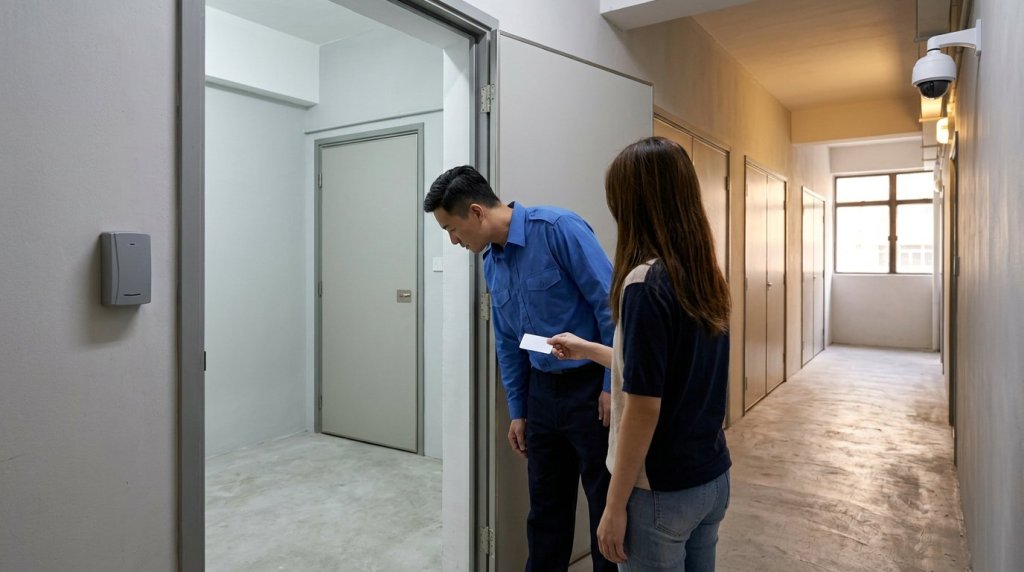
When choosing a self-storage unit, security should be assessed based on practical arrangements, not just marketing claims. First, find out whether the premises have CCTV surveillance and how access control systems restrict entry. The two serve different purposes: cameras monitor comings and goings, whilst access control manages entry permissions.If you are storing goods or work documents, you should factor these arrangements into your decision-making process.
Once the access card is activated, tenants can access their units 24 hours a day. Whilst this makes it convenient to retrieve items at any time, it also means that card management must not be overlooked.Please keep your access card safe and do not lend it to others; if the card is lost, follow the procedures set out in the tenancy agreement. When storing cameras, computers or stock, you may also keep the inventory list separate from the labels on the boxes to avoid exposing the contents of the items.
Temperature and humidity can also affect the condition of your belongings. An air-conditioned storage environment helps to minimise the time items are exposed to stifling heat, but air conditioning does not guarantee a constant humidity level, nor can it replace appropriate packaging. Paper documents, fabrics and electronic devices have varying tolerances to environmental changes.Before storing items, clean them and allow them to dry completely before packing them in suitable containers; avoid sealing damp clothes or equipment that is not fully dry directly into boxes.
For example, when temporarily storing clothes whilst moving house, wash and dry them first before placing them in dry boxes; old documents should be stored off the floor to avoid direct contact with the ground. If items require specific temperature and humidity conditions, a standard air-conditioned environment may not meet these requirements.First, assess whether items are suitable for storage based on their nature; do not assume that all items will be equally protected simply because the storage facility is air-conditioned.
With regard to insurance, it is crucial to clarify what is covered. Insurance covering the building’s structure or the operator’s property does not necessarily cover items stored by tenants. Before signing a contract, read carefully the policy or tenancy agreement to understand the scope of cover, exclusions, claims procedures and the evidence required.If the items are already insured, you should also confirm whether the cover extends to the period during which they are stored away from your home or office.
- Make a list of the items you are storing, noting their approximate value and condition.
- Keep purchase receipts, maintenance records or photographs of the items.
- Check whether the insurance covers the items themselves or only the building.
- Check the documentation required for a claim, as well as any situations where cover does not apply.
These steps will enable you to identify any gaps in cover before storing your belongings. Security equipment, climate-controlled environments and insurance each serve a distinct purpose and cannot replace one another. Taking documents, clothing or electronic equipment as examples, it is easier to determine whether a storage unit is suitable for your needs by first arranging packaging according to the characteristics of the items, and then checking the access controls and terms of cover.
Site Visit and Additional Charges
Floor plans do not reveal every detail. When you arrive on site, walk from the building entrance to the storage unit to check whether the signage is clear and the route is easy to follow.Also pay attention to the width of corridor bends, lift doors and storage unit doors. If you intend to store sofas or display stands, visualise whether the items will pass through smoothly. Once the storage unit door is open, check whether it obstructs the passageway.
During the inspection, walk through the entire process of collecting your items. Start at the entrance, pass through the access control and lift, then follow the corridor to the storage unit.Check whether trolleys manoeuvre easily and whether there are any thresholds or narrow sections along the way. If you are storing goods for an online shop, imagine whether you would be able to organise items and turn round whilst carrying a cardboard box inside the storage unit. If you are storing seasonal clothing, also check whether boxes can be stacked securely.
‘Extras’ do not necessarily refer to costs; they may also relate to additional operational requirements. During the inspection, confirm what handling equipment, lighting and access arrangements the premises have, and check that the warehouse doors, walls and floors are kept clean and tidy.If you need to store long items, make a note of the internal height and any usable corners; if storing boxes of documents, consider whether it will be convenient to retrieve the boxes from the bottom layer. The actual environment makes it easier to spot limitations than simply looking at a floor plan.
- Observe the entire route from the entrance to the storage unit door.
- Pay attention to the clearance at doorways, in corridors and in lifts.
- Check whether boxes or large items can be placed without difficulty.
- Make a note of the on-site facilities and any areas requiring special attention.
For example, if you plan to store furniture for a refurbishment, first visualise how a sofa would navigate a corner, then check whether there is sufficient space inside the storage unit to accommodate it.If you are storing shop stock, assess whether unpacking and organising will be straightforward based on the dimensions of the boxes you typically use. These practical considerations will affect future use, so it is not advisable to base your decision solely on the storage unit’s floor area.
Before leaving, compile an inspection report noting the route taken, the layout of the storage unit, the location of the entrance and the condition of the facilities.Compare what you have observed on site with your own inventory list, then visualise the three steps of storing, retrieving and organising your items. This will provide a clear basis for comparing different storage units and make it easier to identify which space best suits your needs.
Prohibited Items and Safety Risks
The storage rules for different units should be governed by the tenancy agreement and the venue’s terms and conditions.Do not assume that items suitable for your home are automatically suitable for storage. Before signing the contract, identify the clauses relating to ‘prohibited items’ and ‘restricted items’. If the terms mention a specific category of items, check each one by name. If you encounter ambiguous wording, clarify the scope before arranging storage.
Flammable liquids, fuels, fireworks and aerosol cans pose risks related to ignition sources or pressure. With paints, thinners and cleaning products, pay close attention to their ingredients and the condition of their containers.Do not pack these items together with furniture in boxes and store them as ordinary household goods. If the product packaging bears hazard labels, retain the labels and check them against the terms of your tenancy agreement. Under no circumstances should you repackage items yourself or use ordinary bottles to conceal the original labelling.
Leaks and odours can also affect other items. Cleaning products, cooking oil or liquid items may leak due to knocks, even if the containers appear intact. Food may spoil, attract pests or leave odours.First, check bottle caps, seals and outer packaging; do not pack items directly into boxes if they show cracks, signs of leakage or have an unusual odour. Before moving them in, ensure that all food and drink have been removed from bags.
- Check the item names, ingredients and original labels.
- Discard any packaging that is damp, damaged or has leaked.
- Keep food requiring refrigeration separate from everyday household items.
- Check each item against the prohibited and restricted storage clauses in your tenancy agreement.
Assess whether batteries, electronic equipment and battery-powered products are suitable for storage in accordance with the terms and conditions. If a battery has swollen, is hot to the touch or has a damaged casing, do not place it in a cardboard box. Stop using it immediately, avoid storing it alongside metal objects, and do not attempt to dismantle it yourself.Documents, jewellery and collectables present a different kind of risk: once lost, dampened or damaged, they may not be easily replaced. When packing, keep important documents in a separate place and draw up an inventory of the items in each box.
Before storage, sort items one by one according to ‘item, packaging and risk’. First, confirm what the item is; then check for any labels indicating liquids, batteries, odours or flammability; finally, check your tenancy agreement.Do not simply store items in a storage unit just because the outer box is labelled ‘miscellaneous’, particularly unopened boxes left over from a move. If the contents are unclear, open the box to check and relabel it. Clear categorisation reduces the risk of items being overlooked and makes it easier to identify them when you retrieve them later. Only arrange storage once you are satisfied that both the storage unit’s regulations and the nature of the items are compatible.
Estimate the space required and choose a location before renting a storage unit
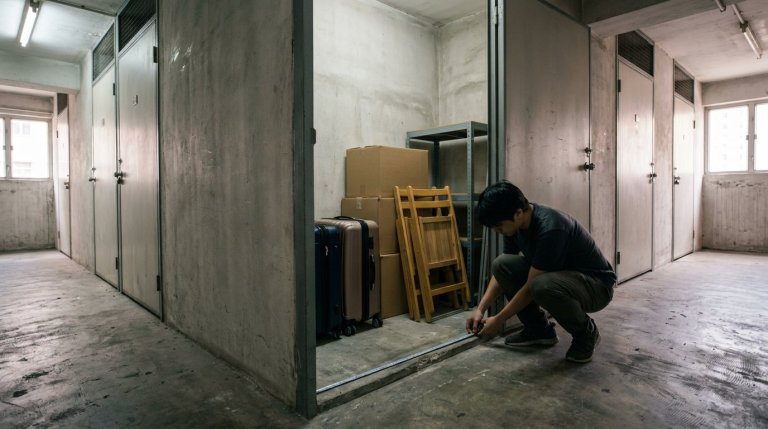
Start by making a list, then estimate the required space. Keep furniture, boxes and equipment separate on your list. For large items, note down the length, width and height. For boxes, estimate the number and dimensions.Do not simply count the number of boxes; the shape of the items inside will also affect how they are stacked. Folding chairs can be folded away, whilst sofas require space to retain their shape.
Next, categorise items by frequency of use. When moving house or carrying out renovations, you may need to store an entire batch of household items at once.Online shops, on the other hand, may need to collect goods regularly. Frequently used items should be placed near the entrance, whilst less frequently used items can be stored at the back. If boxes are stacked high, you’ll also need to leave space for accessing them. Factor all this space into your calculations to avoid estimating based solely on the total volume of the items.
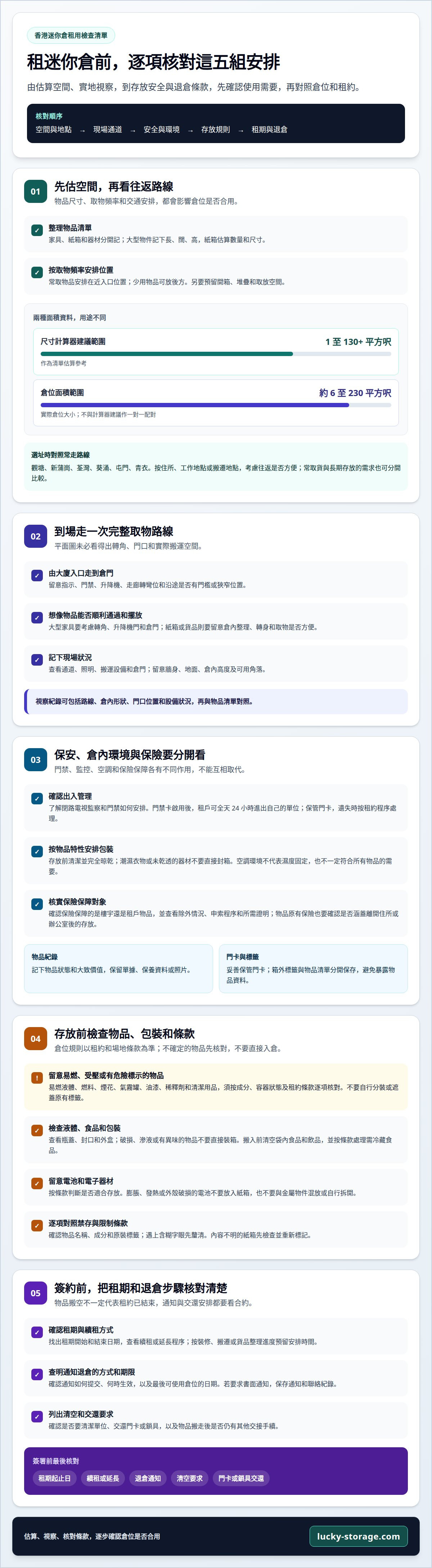
When estimating, you can first enter your list into a dimensions calculator to obtain a preliminary guide to the required area. The recommended ranges for existing calculators can vary from one square foot to over one hundred and thirty square feet;whilst storage unit options in Hong Kong range from approximately 6 square feet to 230 square feet. These two ranges serve different purposes: the former is for estimation purposes, whilst the latter represents the actual storage unit size range; they cannot be treated as a one-to-one correspondence. Furniture dimensions, stacking methods and access routes will all affect your actual requirements.
- Make a note of the dimensions of each large item of furniture.
- Separate frequently used items from those intended for long-term storage.
- Allow space for unpacking, turning round and retrieving items.
- Compare the estimated results from your list with the actual storage unit dimensions.
When choosing a location, consider the route to and from the facility, not just the place name. If you live in Kwun Tong, a nearby storage unit may be more convenient for daily access; if your belongings are mainly being sorted in Kwai Chung, arrangements involving travel to and from Kwai Chung may be more convenient.During a move, you can also work out which area offers the best connections based on your new home, old home or the location of any renovation work. Hong Kong’s Kwun Tong, San Po Kong, Tsuen Wan, Kwai Chung, Tuen Mun and Tsing Yi are each suited to different lifestyle and work routes.
Finally, weigh up how often you’ll use the storage unit against your travel time. If you need to collect items every week, a convenient location may be more practical than a slightly larger unit; if you’re only storing seasonal items, you should prioritise whether the space is suitable for your needs.Organising your checklist, estimated number of collection visits and regular routes before deciding on the size and location of your storage unit will provide a more accurate reflection of your actual needs than simply looking at the square footage.
Tenancy Term, Deposit, Prepayment and Termination Clauses
Before signing the contract, review the tenancy period and termination arrangements together. Confirm the start and end dates of the tenancy, as well as the procedure for renewal. If you are only storing furniture whilst your property is being refurbished, take into account both your expected move-in date and the completion date of the works to ensure that your termination arrangements do not conflict with the renovation schedule.If the tenancy agreement includes automatic renewal or extension procedures, ensure you understand the required steps clearly.
With regard to the terms for vacating the unit, pay close attention to the method of notification and the notice period.Determine the method by which notice must be given, when the notice takes effect, and the final date on which you may use the storage unit. If the contract requires written notice, verbal notification may not be sufficient. Keep a record of the date of notification and any correspondence; this will make it easier to proceed in accordance with the contract when arranging to vacate the unit.
There are specific steps involved in clearing out the storage unit. Check whether all items must be removed, whether the unit needs to be cleaned, and how access cards or locks should be returned.If you are moving out at the end of the month, check how the contract defines the final day of use to avoid confusing ‘the unit has been cleared’ with ‘the tenancy has ended’. If the terms mention the handover of the storage unit, also note whether any further formalities need to be completed after handover.
- Make a note of the start and end dates of the tenancy in your calendar.
- Make a note of the method and deadline for giving notice to vacate the storage unit.
- Make a list of the requirements for clearing out the storage unit.
- Confirm the arrangements for returning access cards or locks.
For example, if renovation work is delayed, the original move-out date may need to be adjusted.Check the renewal or extension procedures in the tenancy agreement before arranging for your belongings to be removed. If the storage unit contains goods for an online shop, you may also need to allow time for removal in line with restocking and organisation procedures to avoid any boxes remaining uncollected at the last minute. After each communication, keep a written record and note the date and the matters confirmed.
Before signing, use a checklist to verify the tenancy period, renewal terms, notice of termination, clearance requirements and return procedures.Locate the corresponding clauses in the contract for each item; if the clauses are scattered across different sections, make a note of the headings to facilitate future reference. Once you have completed your checks, arrange for move-in and move-out dates based on your anticipated storage period to ensure the entire process runs smoothly.
Lucky Storage
Lucky Storage can help you organise your space requirements and estimate the area you’ll need using the size calculator based on your inventory list. If you require workspace, you can also explore our mini-office options.
When contacting us, please first outline the items to be stored, your collection habits, preferred location and expected tenancy period, so that we can organise your requirements and then consider suitable arrangements based on your specific needs.
If you’d like to discuss your storage needs further, please feel free to contact Lucky Storage.
Organise your needs and take the next step
You don’t need to have every detail of your storage arrangement worked out in one go. Start by jotting down the issues you’re most keen to resolve—such as whether access to your belongings will be convenient, whether your collection is likely to grow, or whether the tenancy period can align with your moving schedule. This list will help you articulate your needs more clearly and provide a clearer direction for the next steps in renting a self-storage unit in Hong Kong.The Lucky Storage team are experts in self-storage and space planning, and can help you narrow down your options based on your specific needs. Contact Lucky Storage to enquire about renting a unit, organise your space at your own pace, and get started with ease.